

You’ve heard of the 5-second rule for food, but did you know there’s a 10-second rule for websites? That’s how long you have to capture a visitor’s attention when they’re deciding whether to stay or leave.
And what’s the first thing a user sees on your website? Your headline! (After all, it’s right there at the top in big, bold letters)
Is your headline working?
For many small businesses, their website headline isn’t pulling its weight. If the headline is vague, generic, or (the classic) just says “Welcome,” it’s not doing anything in those first 10 seconds to entice your visitors to stick around longer.
And if mayyyybe that sounds like your headline, don’t worry! Even pro copywriters struggle to write great headlines. So let’s dig into into what makes a good website headline and some tricks we can use to give yours a glow-up.
🧐 What makes a good headline?

Headlines have a Sunday-crossword-level difficult job: they have to grab a visitor’s attention, tell them what you do, AND make them feel seen – all without making search engines mad by being way too long.
How to Test Your Headline
To quickly test whether your headline is effective, find someone (who’s not involved in your business, like a friend or neighbor) to read your headline and then ask them two simple questions:
- What do I do?
- Who do I help?
Ideally, they can immediately answer both questions without hesitation. Even if they can only answer one, that’s still a decent headline.
But if they’re totally drawing a blank, it’s time to start over.
Luckily, there’s a simple formula we can turn to that works effectively for small businesses that will help you write a headline that’s clear, specific, and concise.
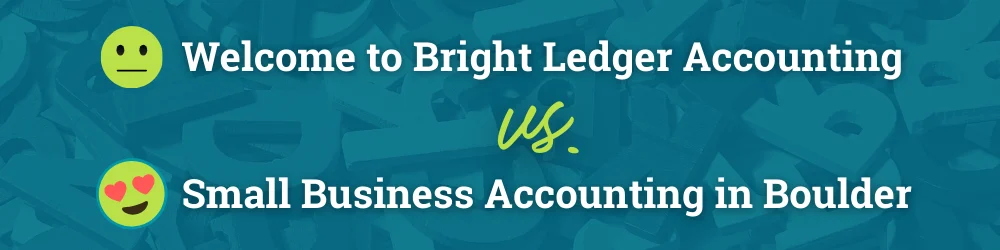
The Small Business Headline Formula
✏️ [What You Do] for [Who]
That’s the formula – it may sound simplistic, but it works! Here’s how it reads in practice:
- Compassionate Counseling for Teens & Adults (Therapist)
- Bookkeeping for Creative Small Businesses (Bookkeeper)
- Brand Design for Women-Owned Businesses (Brand Designer)
📍How to Include Your Location
If you work in a specific area, that’s a great detail to add to the end:
- Nutrition Coaching for Busy Moms in Austin
- Professional Home Cleaning for Families in Boulder, CO
You can also drop the [who] from the end to add your location if it makes more sense for your business:
- A Zero-Waste Refill Market in Erie, CO
- Small Business Accounting Services in Colorado Springs
- Custom Floral Design for Denver Weddings
✏️ A variation: I help [who] with [what]
This is a variation on the main formula that adds a few more characters, but feels a little warmer:
- I help freelancers get organized and paid. (Bookkeeper)
- I help small businesses get found online. (SEO Specialist)
- I help couples plan their stress-free dream wedding. (Wedding Planner)
🧩 Subheadings Add More Detail
If the basic formulas feel a little tooooo direct or succinct, you can pair them with a subheading that goes into more detail or showcases more of your brand’s unique personality:
➡️ Example for [What You Do] for [Who]
- Headline: Professional Organizing for Busy Families
- Subheading: Because life is too short to spend it looking for your keys, your kids’ permission slips, or your sanity.
➡️ Example for I help [who] with [what]
- Headline: I help homeowners design spaces they love.
- Subheading: Say goodbye to Pinterest boards that go nowhere. Let’s create a home that feels authentically you.
You may notice these subheadings are actually accomplishing two things: they’re adding personality AND hinting at the benefit/outcome the client gets – which folks find way more enticing than knowing the details/process of what you do.
🧠 Add Cleverness Here
Speaking of personality: if you have a clever tagline, a bit of wordplay, or a phrase that’s specific to your brand or how you talk about your work, the subheading is a great place to include it.
This gives it a home without confusing search engines or leaving visitors guessing about what you actually do.
Search Engines Read Your Headline, Too
Beyond grabbing your visitor’s attention, your headline also plays an important role for search engines.
Google’s web crawlers read your website headline in order to know what your website is about. So if it just says “Welcome,” you’re not only losing visitors that end up on your website, you’re also preventing people from finding it in the first place.
Thankfully, there’s nothing fancy about what search engines are looking for in a headline: clear, natural language that sounds like something a real person would type into Google is perfect. Oh, and try to keep it to 55 characters – here’s a word count tool to help!
It works out well, because these are exactly the kinds of headlines the formula in this post helps you write!
Stronger Headline = Stronger Website 💪
A specific, concise headline helps out both the visitors who land on your page and the search engines they used to find you. Test your headline, and if it’s not working, use the simple formula in this post to swap it out for one that will truly do its job well.
And if you’re not sure if your website headline is working for you, or you’d like to know how the rest of your homepage is doing, consider grabbing a free Homepage Audit. It’s a kind checkup for your website that shows you what’s working well and what you should tackle next.
👀 Want expert eyes on your website?
I offer completely free Homepage Audits to everyone who joins email community. It’s a very kind (I promise!) look at the things your website is doing fantastically and the things that could make it work even better for your business.